
Remote Video Monitoring vs. Security Guards: Which Security Solution Is Right for Your Business?

When it comes to protecting a commercial property, assets, and personnel, business owners and facility managers face a crucial decision. The traditional approach has long been to hire on-site security guard services. However, the rapid advancement of professional live video monitoring has introduced a highly efficient alternative.
This shift often leads to a common debate: Remote video monitoring vs security guards—which option is truly better?
The reality is that modern commercial security is not a rigid choice between human personnel and technology. Neither solution is universally superior to the other; rather, each serves a distinct operational purpose. The ideal security setup for your facility depends entirely on your industry, specific risk profile, layout, and operating budget. This comprehensive guide breaks down the core differences between live camera monitoring and physical guards, outlines when each solution excels, and explains why a hybrid security approach often provides the most robust protection for Massachusetts businesses.
What Is Remote Video Monitoring?
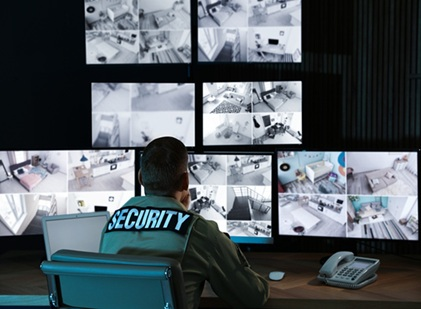
To understand how these systems compare, it helps to establish a clear definition of modern remote surveillance monitoring.
This service connects your physical security camera infrastructure to a secure, off-site central monitoring center. Instead of standard cameras passively recording crime onto a local drive, trained human monitoring specialists actively watch your live video streams during designated high-risk hours. Backed by intelligent analytics that flag unusual activity, these specialists can verify threats in real time and initiate immediate response actions—such as broadcasting live audio warnings or dispatching emergency services—before a break-in escalates.
Want to learn more about the technical architecture? Read our foundational guide: What Is Remote Video Monitoring? to see how this technology integrates seamlessly with your property.
What Do Security Guards Do?

Physical security guards provide a vital human element that technology alone cannot replicate. A professional guard service delivers tangible on-site asset protection through several core responsibilities:
- Physical Presence: The visible presence of a uniformed guard acts as an immediate psychological deterrent to opportunist criminals and trespassers.
- Access Control: Guards physically manage entry points, check employee credentials, verify visitor logs, and prevent unauthorized vehicles from entering secure gates.
- Active Patrols: On-site personnel conduct regular foot or mobile patrols, physically checking door locks, window seals, and perimeter fencing for vulnerabilities.
- Visitor Management: In high-traffic commercial hubs, corporate offices, or residential complexes, guards greet guests, provide directions, and manage incoming deliveries.
- Immediate Emergency Response: If an incident occurs on-site, a physical guard can provide immediate first-aid, manage crowd control, and guide emergency responders directly to the scene.
Key Differences Between Remote Video Monitoring and Security Guards
| Security Feature | Physical Security Guards | Remote Video Monitoring |
|---|---|---|
| Site Coverage | Limited: A guard can only see what is directly in front of them along their patrol route. | Expansive: Multi-screen dashboards allow specialists to view dozens of camera angles simultaneously. |
| Financial Cost | High ongoing payroll, recruiting expenses, shift differentials, and insurance liability overhead. | Fixed, highly predictable service fees that maximize existing hardware investments. |
| Susceptibility to Fatigue | Vulnerable to human fatigue, environmental distractions, and weather conditions during long overnight shifts. | Highly consistent; automated analytics flag movement so operators remain alert. |
| Response Capability | Provides direct physical intervention, access management, and face-to-face communication. | Delivers immediate off-site intervention via live audio warnings and rapid authority dispatch. |
| Scalability | Scaling up requires hiring additional personnel, managing schedules, and increasing payroll overhead. | Highly scalable; new camera angles can be added to the software matrix instantly. |
| Evidence Collection | Relies heavily on written incident reports and subsequent human recollection. | Generates continuous, time-stamped, high-definition digital video logs of all verified events. |
When Remote Video Monitoring Is the Better Choice
For many operations, live remote surveillance monitoring provides an incredibly effective defense framework that outperforms standalone physical guard posts.
Expansive Properties and Warehouses
Large industrial yards, logistics centers, and sprawling storage facilities are difficult for a single guard to patrol effectively. If a guard is checking the front gate, the back perimeter remains vulnerable. Live video streams cover the entire property footprint simultaneously, leaving no blind spots for intruders to exploit
Multiple Commercial Locations
Managing separate physical guard teams across multiple retail branches or branch offices creates an administrative and financial burden. Remote monitoring centralizes your security architecture, allowing a unified team to protect multiple geographic locations from a single dashboard.
Overnight and Holiday Supervision
Most property crimes occur when facilities are closed. Utilizing professional monitoring specialists to secure your business overnight, over weekends, and during holiday shutdowns provides continuous, unblinking protection during your highest-risk windows without incurring steep holiday guard payroll costs.
Budget-Conscious Asset Protection
If your business requires comprehensive perimeter protection but cannot justify the steep operational costs of full-time, round-the-clock physical guard shifts, live surveillance offers an excellent return on investment by maximizing the capabilities of your existing hardware.
When Security Guards Are the Better Choice
There are clear scenarios where the physical presence and direct problem-solving capabilities of an on-site security guard are absolutely necessary.
Rigorous Access Control
If your facility requires a human professional to physically check identification badges, inspect vehicle cargo bays, issue visitor passes, or sign for high-security commercial deliveries, a physical guard is indispensable.
High-Traffic Entrances and Hospitality
Properties like busy corporate lobbies, large medical campuses, and major hotels benefit immensely from the customer service aspect of security personnel. Guards manage visitor interactions, diffuse minor customer service disputes, and provide a welcoming presence.
Direct Physical Intervention
When an incident requires direct, on-the-scene human management—such as safely escorting an unruly individual off the premises, managing traffic flow during a utility failure, or physically securing a broken perimeter door—an on-site guard is required.
Why Many Businesses Choose a Hybrid Security Approach
The most sophisticated commercial security strategies do not treat technology and human guards as opposing forces. Instead, they combine them into a unified, hybrid security model.
This approach pairs the broad visual coverage of live video tracking with the target-specific capabilities of physical guard services. When implemented correctly, it creates a powerful, responsive security network that optimizes payroll costs while maximizing site protection.
Cameras Monitor the Property Footprint:
Phase 1: Expansive Oversight.Instead of relying on a guard to walk a slow patrol loop, your existing camera framework continuously watches your entire site perimeter, dark alleyways, loading docks, and access gates simultaneously.
Monitoring Specialists Analyze the Threat:
Phase 2: Live Verification.If an intruder attempts to scale a fence or access a restricted area, an alert triggers. An off-site monitoring specialist immediately reviews the live stream to confirm the threat, filtering out false alarms caused by animals, wind, or weather.
On-Site Guards Respond Safely:
Phase 3: Targeted Deployment.Rather than wandering blindly into a potentially dangerous situation, your on-site physical security guards are immediately dispatched to the precise coordinates of the incident. They arrive with real-time tactical intelligence, knowing exactly how many individuals are involved and what they are doing, resulting in a safer and more effective intervention.
Ready to combine technology with physical defense? Learn how our unified approach optimizes your budget and eliminates vulnerabilities by visiting our specialized service page: Remote Monitoring with Security Guards.
Analyzing the Real-World Cost Comparison
While exact pricing varies significantly based on site layouts, insurance mandates, and localized risk tiers, the cost-benefit analysis between these two approaches remains consistent.
Hiring a single full-time on-site security guard to cover a 24/7 post requires managing holiday rotations, payroll taxes, insurance benefits, and overtime shifts. If your facility requires multiple guards to cover vast acreage or protect multiple entrance points, these expenses scale upward rapidly.
Live remote camera tracking provides a far more scalable structure. Because it relies on software integration and shared monitoring center efficiencies, it allows you to maintain comprehensive, multi-camera perimeter coverage at a fraction of the cost of traditional security personnel payroll. For businesses looking to optimize their operational overhead, transitioning overnight security to a remote center while retaining a physical guard presence during high-traffic daytime hours offers an ideal balance of fiscal responsibility and thorough protection.
Which Industries Benefit Most from a Unified Strategy?
Adapting your security stance to your specific sector ensures that your defensive resources are used efficiently where they matter most.
- Warehouses: Large logistics hubs utilize hybrid security to protect millions of dollars in freight, monitor expansive loading docks, and keep eyes on unlit outdoor trailer yards overnight. Explore our Warehouse Security Solutions.
- Retail Stores: High-volume shopping venues leverage live cameras to track sales floors and backrooms while utilizing visible on-site personnel to deter active shoplifters at exit points. Review our targeted Retail Stores Security Services.
- Property Management: Multi-family housing structures and commercial properties combine systems to protect parking areas from vehicle break-ins while ensuring common areas remain secure. Secure your properties via Property Management Monitoring.
- Parking Lots: Open parking structures use continuous camera feeds to monitor distant corners while directing mobile patrols to investigate suspicious vehicle gatherings immediately.
- Hotels: Sprawling hospitality layouts utilize remote specialists to keep watch over secondary exits, stairwells, and remote amenities, allowing front desk teams to focus entirely on guest services.
- Manufacturing Plants: Industrial facilities track safety protocol compliance and monitor heavy machinery yards overnight, protecting expensive tooling assets from copper and equipment theft.
- Banks: Financial institutions require multi-layered protection that pairs high-security vault monitoring with instant authority dispatch capabilities.
- Cannabis Facilities: Highly regulated grow operations and dispensaries utilize integrated monitoring to meet strict state logging requirements and maintain airtight compliance across all vault zones.
Why Massachusetts Businesses Are Combining Both Solutions
From high-density commercial centers to industrial transport hubs, companies across Massachusetts require security strategies that are both adaptive and reliable. EndOfTheft provides localized, responsive security coordination designed to safeguard assets across the diverse operating environments of the Commonwealth.
Our surveillance teams and guard networks support commercial facilities across key metropolitan areas:
- Optimizing corporate footprints and managing high-value assets in Boston.
- Securing large distribution hubs, shipping yards, and industrial spaces in Worcester.
- Protecting commercial buildings, loading bays, and multi-family structures in Springfield.
- Overseeing high-tech workspaces, offices, and restricted corporate facilities in Cambridge.
- Mitigating loitering, perimeter breaches, and asset losses in Lynn.
By understanding the distinct security challenges of each municipality, we help you build a defense model that protects your property without adding unnecessary administrative friction.
Frequently Asked Questions
1. Is remote video monitoring cheaper than hiring security guards?
Yes, in the vast majority of applications. Hiring full-time, round-the-clock physical security guards requires significant ongoing investments in payroll, insurance, and shift scheduling. Remote video monitoring leverages your existing camera infrastructure to provide wide-area oversight at a fraction of the cost of traditional manpower.
2. Can remote surveillance completely replace physical security guards?
It depends entirely on your specific property needs. If your business requires physical access control, visitor interaction, or hands-on assistance, you will still require an on-site guard presence. However, for properties where the primary goal is overnight perimeter defense, asset protection, and crime deterrence, remote monitoring can often replace static night-shift posts entirely.
3. When should a business consider using both solutions together?
A hybrid approach is highly recommended for large, complex facilities—such as distribution warehouses, construction sites, and large residential properties. Using cameras to cover wide perimeters while utilizing on-site guards to handle direct physical responses ensures comprehensive protection with optimized labor costs.
4. Can our business use its existing camera system for remote tracking?
Yes. One of the main benefits of working with EndOfTheft is the ability to connect your existing IP, CCTV, or analog camera systems straight to our off-site monitoring dashboards using secure bridging software. This eliminates the need for expensive upfront hardware investments.
5. Which security option is best suited for an industrial warehouse?
Because warehouses feature large square footage, high-value inventory, and numerous blind spots, a hybrid security model is usually the most effective choice. Remote specialists can continuously track all perimeter fence lines and loading docks, allowing a smaller on-site guard team to focus their attention exactly where an active threat is detected.
Final Thoughts
Choosing the right security setup does not mean choosing between technology and human professionals. Standard recording cameras only document a loss after it happens, while standalone guards can easily be limited by blind spots or fatigue. By understanding the distinct strengths of both live remote video monitoring and physical guard services, you can design a balanced, highly responsive security strategy that fits your budget.
Schedule a Free Security Assessment
Unsure which security combination is right for your commercial property? Contact our technical team today to schedule a comprehensive site assessment. We will analyze your vulnerabilities, review your existing camera setup, and help you design a cost-effective strategy to protect your business assets.